

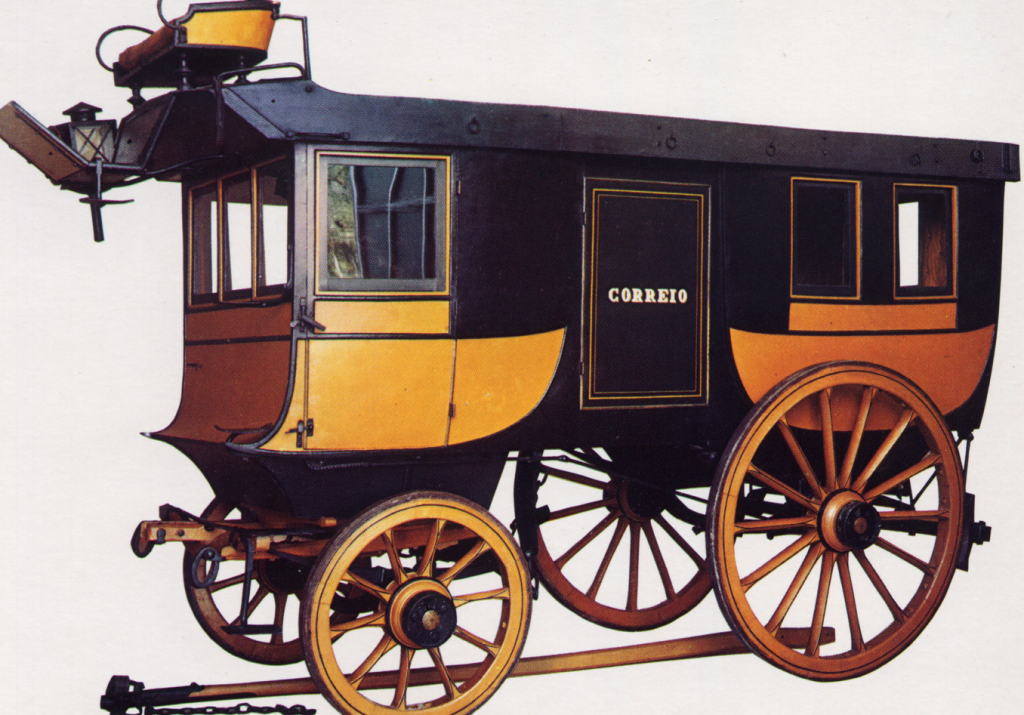
Mala-posta in Portugal
Before the advent of the train, mail transport in Europe was done by carriages that travelled on the main routes to guarantee mail deliveries with some regularity. Countries adopted the use of this means of transportation as road networks were built and improved because carriage travel depended on the existence of good roads.
At the end of the 18th century, Portugal still had a deficient road network, lagging far behind other European countries where mail delivered on foot or horseback had already given way to the carriage known as the mala-posta.
In 1797, the Office of the Postmaster General, which had been in the hands of the Gomes da Mata family for almost two centuries, was abolished. The State took over the postal service operations and immediately proceeded to remodel and modernise it to meet the more demanding needs of a population with different economic and cultural interests.
José Diogo Mascarenhas Neto was appointed General Superintendent of the Kingdom’s Post Office and became responsible for the Mala-Posta (mail-carriage) service. He authored “Methodo para construir as Estradas de Portugal” (Method for building the Roads of Portugal) and “Instruções para o estabelecimento das diligências entre Lisboa e Coimbra” (Instructions for the establishment of the diligences between Lisbon and Coimbra).
In 1804, the mala-posta route from Lisbon to Coimbra took approximately 40 hours and was provided three times a week. The coaches would leave Lisbon and Coimbra at the same time and meet in the middle of the journey, where the passengers would spend the night, and the horses could rest. Then, they would continue the trip to their destinations the following morning. The accommodations were simple change-over stations marked with royal arms.
After only six years of operation, the mala-posta service was suspended, mainly because it was extremely expensive and did not bring profits to the kingdom’s coffers. As a result, the transport of people and goods was once again ensured only by sea.
The service was only effectively resumed in 1852, with António Fontes Pereira de Melo at the head of the Ministry of Public Works. The construction of many kilometres of new roads (using the “Mac Adam” method with small stones and gravel) made it possible to connect the capital to Portugal’s second major city, Porto.
The country was going through a significant development phase reflected in several areas. One of these was communications, both at the postal and telecommunications level, with the introduction of telegraphy, which was initially visual and then evolved to electrical.
The connection from Lisbon to Coimbra became faster, down from 40 to 23 hours. The Lisbon – Porto route took approximately 34 hours. Twenty-three changing stations were distributed around the country, characterised by the simple architectural style that typified them.
Queen D. Maria II and the royal family were among the first people to travel on the mala-posta on a visit to Porto. In addition, they took the opportunity to travel to other cities in the country’s north. In 1871 the last carriage of the mala-posta circulated on the route Porto-Braga-Guimarães. In the following years, mail started to be delivered by train.
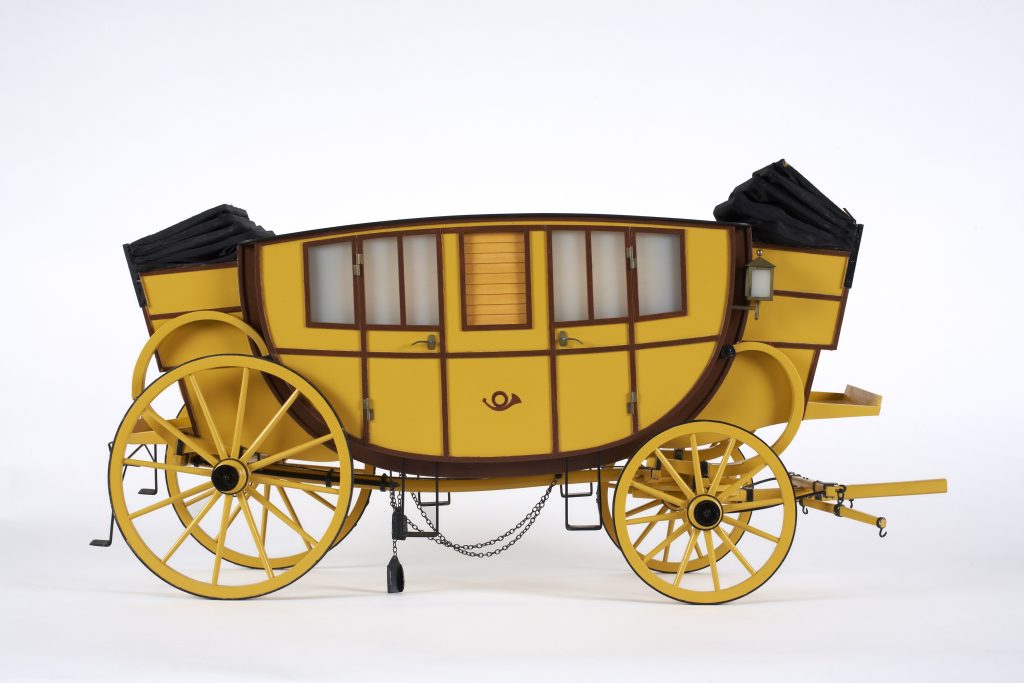
Stagecoach diligence in Slovenian territory
A stagecoach, known in French as diligence, arrived in modern-day Slovenia’s territory in the second half of the 18th century. Empress Maria Theresa introduced fast mail coaches to promote the development of the mail service and replace slow and uncomfortable carriages. As early as 1750, stagecoaches ran twice a week on the route Graz – Maribor – Slovenska Bistrica – Konjice – Celje – Vransko – Podpeč – Ljubljana – Trieste. At that time, postal service operators also took the lead in passenger transport, and private carriers were increasingly sidelined.
The stagecoaches were four- or eight-seater spring-suspended mail carriages with padded interiors, which were quite comfortable to travel in. Running to a regular schedule, they were usually drawn by horses. Staging (travelling in a stagecoach) was scarce and expensive in the 18th century. The price depended on the trip distance and the number of horses, and there were also tributes to pay to the postillion, a fee for wheel greasing, road and bridge tolls, and other duties. Passengers had to pay in advance, and they were guarded and overseen by the so-called shotgun messengers en route. The journey from Vienna to Trieste, with short stops for replacing horses, overnight stays, snacks, and lunches, took three days.
The increase in road traffic in the 19th century caused huge problems. As a result of inefficient organisation, poor roads, and frequent attacks by robbers, the service was only available during daylight hours until the mid-century. As a number of passengers complained about road safety, other drivers were forced to keep out of the way of the stagecoach. The postmasters had to have a good stable, plenty of fodder, horse tack, and a maintenance workshop for the coaches. The postillions were expected to provide the passengers with every comfort possible. Stage stations held the books of complaint, which were regularly sent to higher instances for inspection.
The development of railways brought an end to the golden age of stagecoaches. Posts were gradually abandoned, and many postilions and other postal workers were stripped of their source of income.
 |
 |
|---|---|
| Mala-Posta (mail-carriage) from Lisbon to Porto by Carrosserie du Chemain-Vert Paris. Photo credits: Fundação Portuguesa das Comunicações. | Model of a diligence stagecoach. Photo: Nada Žgank, Domen Pal. |

