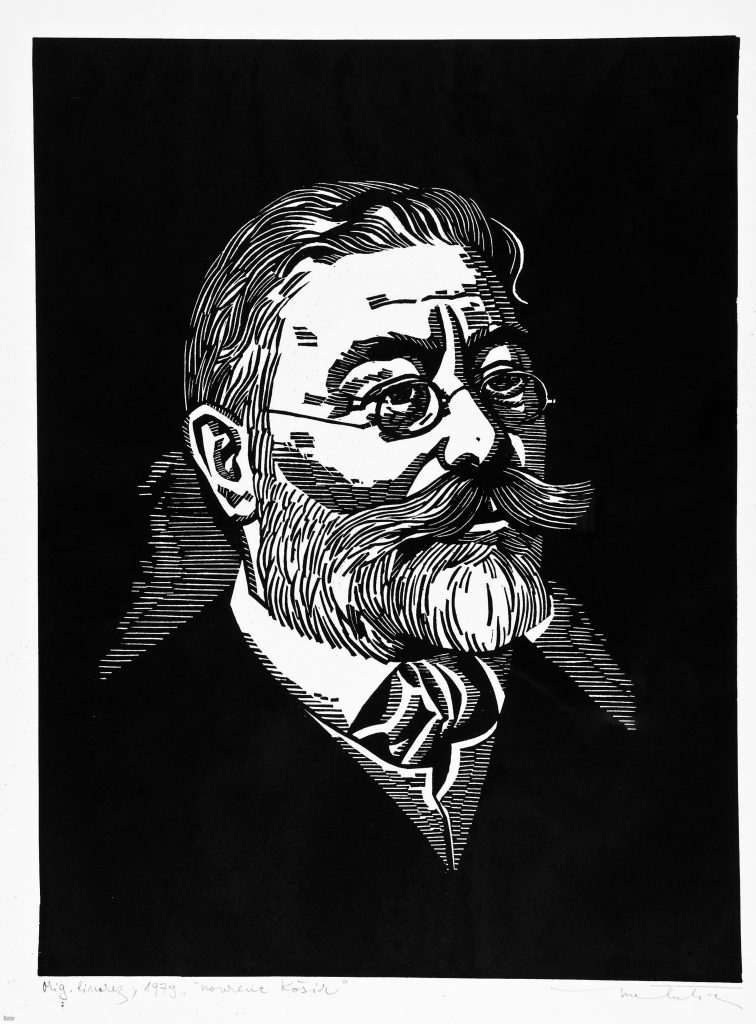
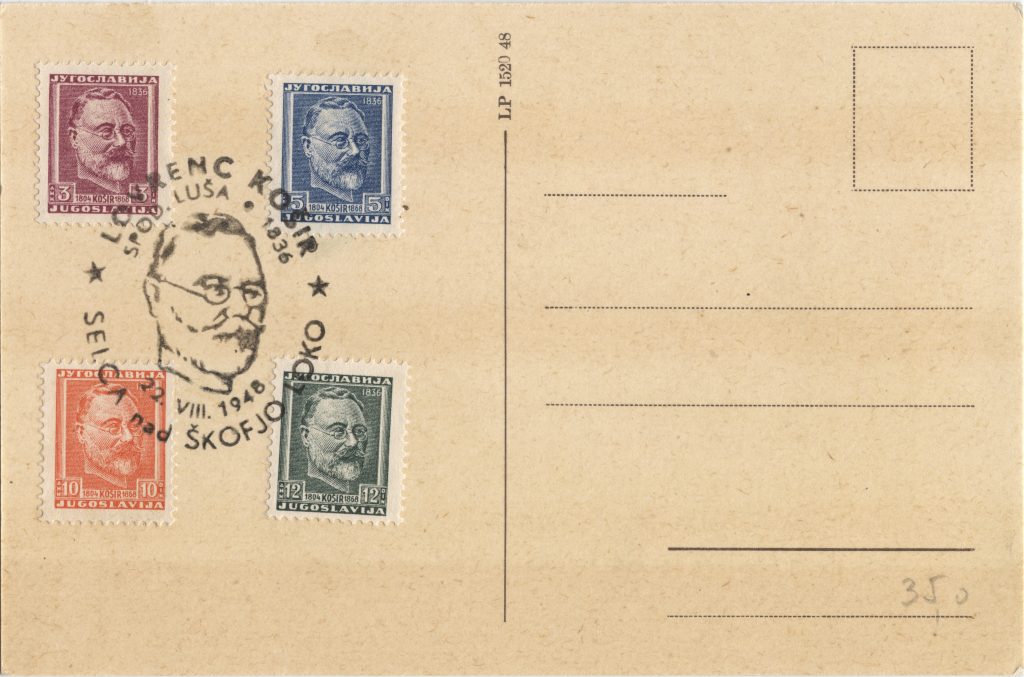
Lovrenc Košir, postal reformer
Lovrenc Košir, a civil servant with the Austro-Hungarian Royal Postal Accountancy Office, proposed improvements to the postal service and the introduction of the postage stamp in 1835. His idea was rejected by the relevant authorities in Vienna. His later efforts to be acknowledged as the inventor of postal stamps were all in vain. Košir was born on 29 July 1804 in Spodnja Luša near Škofja Loka, Sloveni. From 1819 to 1825, he first attended the Juventus Gymnasii Academici and then the Jesuit lyceum in Ljubljana to study a so-called ‘philosophy’ course adapted to the requirements of civil servants. Always a brilliant student, Košir finished his schooling by studying agriculture at the Ljubljana Imperial & Royal Lyceum.
In 1828, he got employment within the administration of the Imperial & Royal Commissariat in Ljubljana. He was transferred to Italy the following year, where he held a series of posts in the civil service, starting as a probationer in the Imperial & Royal Central State Accountancy in Venice to be promoted to First-Degree Assistant in Milan. By this time, he was dealing with the calculation of postal traffic within the Kingdom of Lombardy–Venetia.
In 1834, Košir was summoned to Vienna to commence employment at the Imperial & Royal Postal Accountancy, the highest such office in the Empire. Soon after submitting his proposal, but before it was rejected, he was relocated to Ljubljana to take the post at the Illyric State accountancy office.
On 10 May 1841, he married Amalia Pluschk, the niece of Thomas Pluschk, the Villach Governor General and Provincial Councillor. They had three children; a daughter Ana, and sons Theodor and August. In 1851. the family moved to Zagreb, where Košir took the position of accounting councillor. In the 1870s, he lost his entire family, who all died of tuberculosis. He moved to Vienna in 1875 where he died on 7 August 1879. He is buried at the central cemetery in Vienna.
On 31 December 1835, Lovrenc Košir submitted a proposal for a reform to the system of postal accountancy to the Imperial & Royal Chamber. Following the adoption of new rules on letter fees on 1 June 1817, the mail tariff system within the Austrian monarchy was highly complicated, leading to many mistakes, typically at the detriment of the state. Košir proposed a more efficient and simplified method – the introduction of tax postmarks, a postage stamp, which would facilitate keeping account of paid postage. His aim was not the reform of the tariff system – he did not anticipate the unification of tariffs – but rather a simplification of accountancy procedures. He attached sample letters with stamps illustrating his idea to his proposal. Stamps would be printed in booklets that he called boletariji. He did not address the issue of where and how to attach a stamp to the letter. Quite obviously ahead of its time, the relevant authorities failed to endorse his idea. Retrospectively, Košir often attempted to be acknowledged as the inventor of postal stamps, but unfortunately, his original proposal documents were lost, and all his efforts were in vain.
The world’s first adhesive postage stamp were introduced on 1 May 1840 in Great Britain following Rowland Hill’s idea. Soon afterward, stamps would be used elsewhere in the world. The Austrian monarchy, which at the time included the territory of modern-day Slovenia, issued its first stamp a decade later.
Lourenço Araújo and the Letters Scale
On World Science Day, we highlight Lourenço António de Araújo (1768), the inventor of the Letters Scale, which had a strong impact on the organization and progress of the postal service. Through his father, he became an official at the Secretariat of State for Maritime and Overseas Affairs, and shortly after, he was promoted to a higher-ranking position. In 1810, he was appointed Inspector General of the Post Office and Postal Services of the Kingdom, a position he held until the end of his life.
During his administration, a major postal system reform took place through the “General Regulations for the Postal Service and its Dependencies” of 1815, and the “Schedule of Departure and Arrival Days for the Post” of 1818.
Among the numerous measures taken by this inspector, he considered very important to improve the weighing and postage system for correspondence to generate more revenue for the postal service. The idea of introducing practical and sensitive scales at the post stations became evident.
At the time, postage fees were determined based on weight and distance. The distance was divided into five zones, measured every 10 leagues up to 40 leagues, and then beyond 40 leagues; as for weight, it ranged from a “simple letter” to a letter weighing “6 octaves to 1 ounce” (1 ounce = 28.35 g). This system of weighing letters was complex and, on the other hand, significantly increased the costs borne by the recipients. Those who lived at greater distances could not always afford the postage fees for the received letters, so letters were often left unclaimed at the post offices, resulting in less revenue for the service.
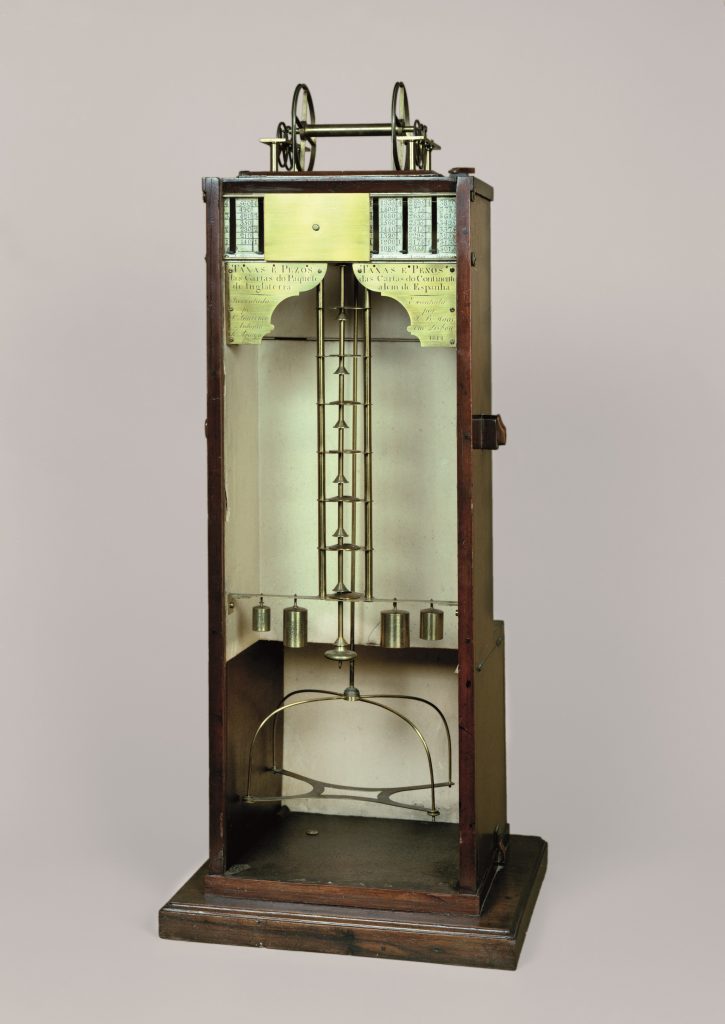
It was in this context that Lourenço Araújo invented the Letters Scale. It was a scale made of wood and metal, with a plate on which the letter was placed, and the cursor moved until it stopped at a point on the table, immediately giving the correct rate to be paid. The great innovation of this scale was not in weighing, but in indicating the correct rate for each type of letter, making this process much more reliable and faster than before. It was particularly important for the taxation of letters from foreign countries, by sea or land.
Lourenço Araújo’s three scales were then manufactured in Lisbon by the German Haas family, in 1814, 1816, and 1852. The first two were intended for the letters of the packet from England and the Continent, and the last one was made for the letters of the packets from the Mediterranean and Brazil.
Later, one of the original scales was among the first thirty pieces exhibited at the Museum of the General Directorate, created by Guilhermino de Barros. A copy was given to the German Postal Administration and another to the Postal Museum in Paris.
Lourenço Araújo’s scales are part of the collection of the Portuguese Communications Foundation and can be visited at its museum or museum reserves.
|
|---|