

MAIL ON RAIL
The advent of the railway in the mid-19th century precipitated overall progress, transforming people’s lifestyles and habits, and marked a turning point in postal transportation. The railway’s primary advantage over other modes of transportation was consistent 24-hour service, remarkable speed, and high carrying capacity. Eventually, posts along the newly laid railway tracks were closed, leaving many postilions and other postal staff without source of income. Similarly, roadside inns, horse stables, and roadside blacksmiths saw a decline.
The postal administration resisted integrating the railway into its operations due to the loss of its monopoly on passenger transport. However, it soon recognised the advantages it offered. With the introduction of special mail carriages, a travelling post office or post ambulance (deriving from the Latin word “ambulāns”, meaning travelling) emerged as the primary means of transporting mail.
The first railway connection in modern-day Slovenia ran from Graz via Maribor to Celje (1846), then to Ljubljana (1849) and Trieste (1857). As early as 1857, the first travelling post office in Slovenia was introduced on this line aboard a regular passenger train.
Railway station offices were established in major junction points and urban centres as traffic grew. The Ljubljana Post Office II began operating at South Station as early as 1852. Operating as mobile divisions of the permanent railway station offices, each travelling post office was indicated by the terminal points (starting and ending station) and route number, for example, Ljubljana—Beograd 3.
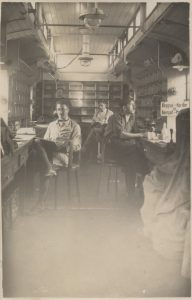
At first, post ambulances didn’t use purpose-built carriages, but the increase in traffic prompted the Post Administration to employ four-axle Pullman-type carriages in 1858. The carriage was divided into two compartments. One had storage space for parcels and mail bags, and the other storage space for letters and postal distribution space where postal clerks sorted and distributed mail. A special regulation, which applied to the mail carriage’s appearance, required a uniform colour scheme: green, with black enamel fittings and fixtures, and topped with a grey roof. Even the colour of signs, as well as storage and toilet walls was prescribed. The furniture was to be in oak ochre.
The travelling post offices were staffed with postal clerks who sorted and dispatched mail en-route in order to speed delivery. As post ambulances had letter boxes where mail could be posted, each had an identifying postmark which was stamped on such mail.
In the early 1920s, twenty travelling post offices were operating in Slovenia. To handle the increase in volume of parcel post at the end of 1920s, dedicated ambulances were put in operation. When the Second World War ended, railway continued to play an important role in mail transportation. Due to huge devastation and shortage, the horse-drawn carriages, feet couriers and first regular bus routes were employed to carry mail immediately after the war. At the beginning of the 1950s, mail transport fleet included 41 carriages, 18 vans, 269 carts and 189 bicycles. Mail was also carried on 83 bus routes.
In the early 1960s, travelling post offices began to be phased out in the then Yugoslavia, and by 1962, only seven were still running on trails. By the end of 1980s, there were only four left in operation on the Ljubljana—Zagreb and Ljubljana—Belgrade routes. The travelling post office with postal workers, running between Ljubljana and Zagreb, was discontinued on 28 August 1991, although mail was carried in unstaffed carriages on this route until 1996.
TRAIN AS MAIL TRANSPORTATION
The evolution of transportation has always been crucial for the development of communications. In the mid-19th century, the policy adopted by Fontes Pereira de Melo (Minister of Public Works) in the construction of new roads allowed for accelerating the mail service in the transportation of correspondence and people. However, the connection from the capital to the main cities in the North remained very slow and excessively expensive. It became increasingly important to keep up with the progress that Europe was experiencing with the introduction of the steam locomotive. The development of the railway would bring to the country greater ease and speed in the transportation of mail, as well as a significant reduction in costs, making communication between populations more accessible.
On October 28, 1856, the railway line in Portugal was inaugurated, with a section that connected Lisbon to Carregado. On the very next day, the Sub-Inspectorate-General of Posts and Post Roads of the Kingdom placed the first mail bags on the railway – fulfilling the contract established between the government and the Royal Company of Railways, which imposed the free and proper transportation of mail bags and their drivers in wagons on the faster trains. Thus, the beginning of a significant modernization in the postal service was marked.
Later, with the approval of establishing mobile postal stations on the railways, the Sub-Inspectorate-General negotiated with Germany for the purchase of eight “postal ambulances” carriages.
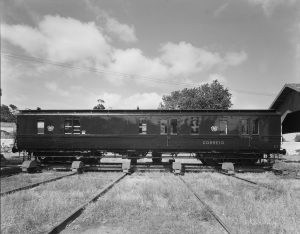
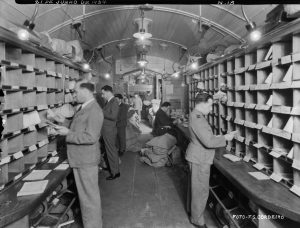
The mail wagons were attached to the other carriages of the train and served as itinerant post offices. Postal employees, properly trained were responsible for the postal processing along the routes, allowing the sorting of letters by destination and the collection of correspondence in boxes at the station stops along the railway lines. The processing of correspondence was done in special cabins without interruptions, requiring employees to work day and night.
The activity of postal ambulances shortened the distance between many localities in the country, while telegraph lines were also forging their way, allowing a new way of communication.
Except for the period 1869-1875, when the crisis in the country forced the suppression of mobile postal stations, their activity was in full swing until 1990 when they were replaced by road transportation.
 |
 |
|---|---|
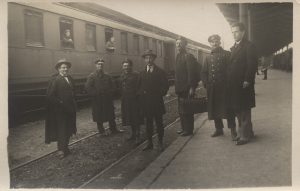
| Inside of a mail carriage, interwar period. Documentation Technical Museum of Slovenia. | Postal employees at the main railway station in Maribor, Slovenia, interwar period. Documentation Technical Museum of Slovenia. |
 |
 |
|---|---|
| Documentation Fundação Portuguesa das Comunicações | Documentation Fundação Portuguesa das Comunicações |

