

The History of Communications is marked by creation, experimentation and patenting. Memorable for the commitment and talent of many of its inventors. This month, we recover the story of two creators in the Connecting Stories project. Each one in their own country sought to innovate and make a difference. This is the story of the Portuguese desk phone, designed by Cristiano Bramão, and the Iskra ETA 80 phone created by Davorin Savnik, a Slovenian designer prized for his creation.
Bramão telephone
At 15, Cristiano Augusto Bramão enlisted as a volunteer in the 2nd Artillery Regiment. Four years later, as a 2nd Sergeant, he asked for a transfer to the telegraphic corps. In 1864, that body was demilitarised, and Bramão received the rank of 1st class junior telegraphist, becoming 2nd class chief telegraphist soon after. Again promoted, he became 1st class telegraphist.
Throughout his career, he was recognised as an apt and intelligent employee in the various tasks he performed, whether experiments with electricity or acquiring telegraphic material, among others. During this period, Bramão carried out many experiments and developed equipment in the telegraphy and telephony fields.
Some of them were presented at the Paris Universal Exhibition in 1878 on behalf of the Telegraph Office. Bramão introduced three different Bramão telegraphic devices in the French capital, co-created with builder Maximiliano Augusto Herrmann. The enormous success of the presentation led to a Diploma of Honour being awarded to the Portuguese telegraph office, alongside such well-known names as Baudot, Bell, and Edison, among many others.
Bramão ‘s continuous research work led him to create two telephones. The desk phone (hands-free telephone kit) contained a loudspeaker function. It was the first telephone in the world to have the microphone and handset incorporated into a single piece, a comfortable way to listen and write simultaneously, a simple piece, easy to tune and regulate the sound intensity. Bramão also invented the battery telephone and the handset, an addition that only came into use and large-scale production in the 20th century.
Although Bramão succeeded in improving the performance of equipment created by other inventors, his name did not become internationally known because his inventions were not presented in his name, presumably due to a lack of resources and also because he died prematurely.
During his short 41 years, Bramão invented three telegraphic devices, two galvanometers, a telegraph table, the desk-top telephone and the battery-operated telephone. To learn more and get a closer look at some of these devices, visit the “Conquering Distance” exhibition at the Communications Museum.
ETA 80
Founded in 1946 in Kranj, Iskra was Slovenia’s first electrical engineering and precision mechanics factory. Initially employing 850 workers, it developed over the following decades into the largest electrical engineering company in the then common state of Yugoslavia. A year after its foundation, Iskra decided to enter the telecommunications market. They set about developing critical components for a new telephony programme, followed by the first plans for telephone exchanges.
Iskra’s first ITV 1 telephone was made under Siemens licence. This induction telephone with a metal housing was primarily intended for railway and state institutions. In 1950, Iskra introduced the first models of the ATA automatic telephone series. In 1956, the ATA 11 and ATA 12 were the phones of choice among users. Predominantly produced in black, the housing made of Bakelite was available in six other colours.
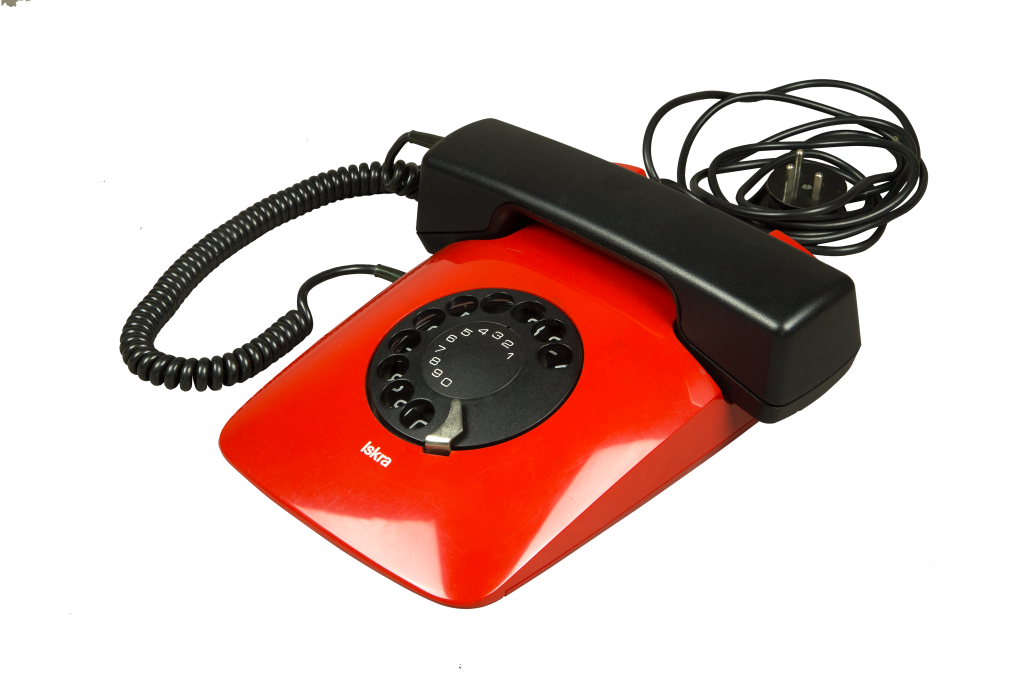
At the Ljubljana Electronics Fair in 1978, Iskra introduced a telephone named Olimpik, designed by Davorin Savnik, one of the pioneers of Slovene industrial design. The mass production of the new phone, officially called ETA 80, started in 1980. Made of thermoplastic, the phones with a rotary dial were initially available in red, yellow, green, and brown. Subsequent models were upgraded with a keypad and other technological innovations; however, the design never changed. In 1980, the ETA 80 became the official telephone of the XXII Olympic Games in Moscow. Because of its eye-catching design and aerodynamic shape reminiscent of a racing car, it was nicknamed Fittipaldi after the famous Brazilian Formula 1 driver Emerson Fittipaldi.
The iconic Iskra ETA 80 became the phone of choice for home and business use and a must-have in every household. More than five million devices have been manufactured in Kranj. In the first years after its creation, it won several international design awards. As Iskra failed to protect its design adequately, the phone was copied on a massive scale. Goldstar alone, the forerunner of today’s Korean electronics giant LG, is said to have sold some 160 million copies of the phone. The ETA 80 is considered one of the most copied Slovene products, with between 200 and 300 counterfeits reportedly made worldwide. Professor Rido Busse, the founder of the Plagiarius Museum in Solingen, Germany, has granted sixteen negative Plagiarius awards to the most flagrant ETA 80 imitations.
Due to its impressive and distinctive design, the phone made it to the industrial design collections of the Museum of Modern Art (MoMA) in New York and The Design Museum of Munich’s modern art museum Pinakothek der Moderne.
 |
 |
|---|---|
| The desk phone (hands-free telephone kit) by Bramão. Property of: Fundação Portuguesa das Comunicações, Iconographic archive; Photo: Pedro Ferreira | Iskra ETA 80. Property of: Museum of Post and telecommunications; Photo: Marko Cotič Trojer |

